Breast Augmentation
Breast augmentation, also called “augmentation mammaplasty,” is a procedure designed to enhance the size and improve the shape of a woman’s breasts through implants.
Model
Breast implants can be placed for medical needs, such as in breast reconstruction after cancer treatment, or to enhance the cosmetic appearance of the breasts.
They also come in different shapes and sizes. The implant shell is made of silicone, and implants may be filled with silicone gel or saline.
If you’re considering breast augmentation surgery, schedule your consultation with a plastic surgeon to understand what breast augmentation surgery entails, including possible risks, complications, and realistic expectations.
How Do I Know If a Breast Augmentation Procedure is Right for Me?
Women have many different reasons for choosing breast augmentation surgery, but most of them fall into one of these four categories:
Naturally Small Breasts
Women who have small breasts or asymmetrical breasts due to genetics can achieve enhanced volume and natural-looking results with breast augmentation.
Change in Breast Size After Pregnancy
Pregnancy and breastfeeding often lead to a reduced breast size and cause a deflated breast appearance. Breast augmentation can help restore your original breast volume or increase your breast size for a fuller, larger look.
Breast Revision
If a previous breast surgery was unsatisfactory, a secondary breast augmentation can be performed to meet your size expectations or correct the desired upper breast fullness.
Sagging Breasts
Aging, pregnancy, and significant weight loss can cause the breasts to sag and have a poor shape. A breast augmentation (often performed with a breast lift, as implants for this reason are limited for optimal results) can improve the shape of the breasts and provide a more youthful appearance.
Model
Breast Augmentation Options – Silicone vs. Saline
Silicone Breast Implants
- FDA-approved for women 22 years or older
- Pre-filled with silicone gel
- Lower rate of rupture than saline implants
- Said to feel more natural than saline implants
Saline Breast Implants
- FDA-approved for women 18 years or older
- Filled with sterile saltwater solution after insertion
- If a rupture occurs, it will be noticeable immediately
- Size can be adjusted during surgery
Breast Augmentation vs. Fat Transfer: Which Is Right for You?
If you desire fuller, more youthful breasts but want to avoid foreign implants in your body, you may be wondering about the differences between breast augmentation vs. fat transfer.
Also known as natural breast augmentation, fat transfer breast enhancement uses excess fat from one part of your body and transfers it to the breast to increase volume and shape. This procedure provides a more natural alternative to traditional breast implants.
Breast Augmentation With Implants
Traditional breast augmentation uses silicone or saline implants to increase size, improve symmetry, and redefine the chest. As a result, implants offer more flexibility in your size and projection goals, making it a good option for patients seeking more drastic improvements.
Natural Breast Augmentation Through Fat Transfer
Natural breast augmentation uses your own fat instead of implants. During fat transfer breast enhancement, liposuction removes unwanted fat from select areas, such as the abdomen, thighs, or others. This harvested fat is purified and injected into your breasts.
It works best for patients who desire natural-looking fullness rather than noticeable increases.
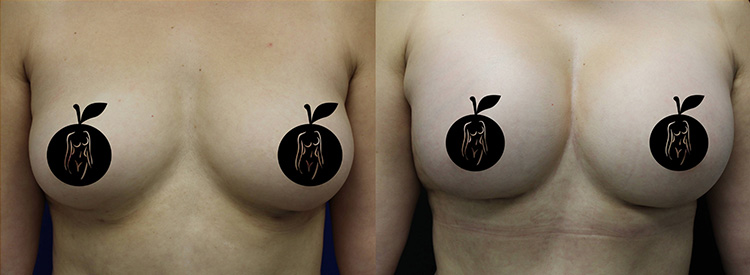
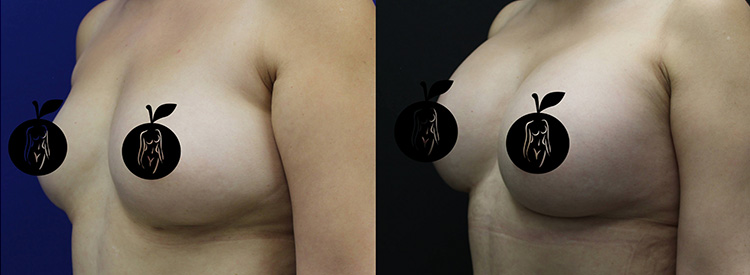
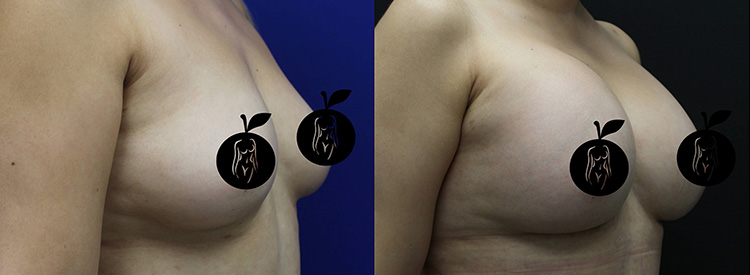
Breast Augmentation Before & After Photos
Details
Three months post-op
- Procedure: Bilateral breast augmentation with 390cc moderate plus Mentor silicone implants
- BMI: 26
- Weight: 150 lbs
- Age: 40 – 50 years
The Breast Augmentation Process
Consultation
Once you fill out the online questionnaire, you will be contacted to confirm an appointment for a one-on-one consultation with the surgeon.
This appointment also includes a review of your health history, medications, and what you hope to achieve with the procedure. Please bring all of this information to your appointment. You can submit all of this information electronically through our HIPAA-compliant patient portal.
The surgeon will discuss the techniques that will best provide you with the results you desire and answer any questions you may have.
Pre-operative Instructions
Your surgeon will review all the information you need to know before surgery in detail.
Generally, patients should avoid nicotine products six weeks before surgery and stop taking anti-inflammatory medication (e.g., aspirin and ibuprofen) for at least two weeks before surgery. Some vitamins and supplements may also cause problems during or after surgery, so avoid them or talk to your surgeon about potential side effects.
You may be asked to bathe using an antibacterial soap before your procedure.
Eating and drinking restrictions include:
- Eight hours before the procedure – stop eating heavy meals or foods, such as meat, fried foods, or fatty foods.
- Six hours before the procedure – stop eating light meals or foods, such as toast or cereal.
- Six hours before the procedure – stop drinking milk or drinks that contain milk.
- Two hours before the procedure – stop drinking clear liquids.
You may be asked to obtain blood tests and/or a mammogram.
Arrange for someone to drive you home and care for you for the first 48 hours after your procedure.
Model
During the Procedure
Breast augmentation is performed under general anesthesia in a surgery center and takes less than two hours. An IV will be inserted into one of your veins. Based on the techniques agreed upon during your consultation, the surgeon will place the implants either above or below the pectoral muscle. Incisions are most commonly made either around the areolas or beneath the breasts at the crease and are closed with absorbable sutures. If only implants are placed, drains are usually not necessary.
Breast Augmentation Recovery
After surgery, your blood pressure, heart rate, breathing rate, and blood oxygen level will be monitored until you leave the surgical center. You may continue to receive fluids and pain medicines through an IV.
You will need to wear compression stockings to help prevent blood clots and reduce leg swelling. You will be advised to wear a compression bra to aid with breast swelling and to keep you comfortable. Breast swelling typically subsides after about three weeks but may last up to six months.
Expect pain, bruising, and tenderness, for which you will be provided pain medications as needed.
For the first few days after surgery, you will need to get plenty of rest. You will be provided with exercises to be performed during your recovery. Most patients can return to work in one week and resume regular exercise after about six weeks.
Your surgeon will provide more detailed information about what to expect during your recovery.
Breast Implant Above vs. Below the Muscle: What’s the Difference?
Where your breast implants are placed changes the appearance of your chest. When comparing breast implants vs. under the muscle, both placements offer unique benefits depending on your goals and anatomy.
Over the Muscle (Subglandular)
With subglandular breast augmentation, the breast implant is placed over the chest muscle, creating more fullness, projection, and cleavage in the upper pole.
- Pros: Easier recovery, no distortion when flexing chest muscles, easier for revision
- Cons: Higher rippling/edge visibility, harder for mammogram screenings
Over-the-muscle breast implants may be best for patients with enough natural breast tissue to support the implant.
Under the Muscle (Submuscular)
Submuscular breast implants are placed partially (dual plane) or fully (total submuscular) under the muscle, creating a smoother, more natural appearance.
- Pros: Less risk of rippling visibility, lower risk of capsular contracture, ages more gracefully, easier for mammogram screenings
- Cons: Harder recovery, possible deformity and shifting when flexing chest muscles
Under-the-muscle breast implants may be best for patients with thinner skin or minimal breast tissue.
Choosing the Right Breast Implant Size and Profile
Choosing the right approach to breast implant surgery depends fully on your own anatomy and goals. Seeing a breast augmentation specialist in Orange County is the best way to determine which implant type is right for you.
During your consultation, Dr. Daniel Urias will analyze your anatomy and listen to your concerns and body ideals. He will then create a personalized treatment plan and discuss which size and profile will work best for you.
Difference Between Moderate vs. High Profile Breast Implants
The breast implant profile is how much an implant projects, which creates more projection on your chest.
- Moderate breast implants: Wider, flatter, with lower projection; best for a natural look.
- High-profile breast implants: Narrow, maximum projection; best for a fuller upper-pole appearance and more cleavage.
The right profile depends on your appearance goals and how natural you want your results to look.
Breast Augmentation FAQs
Q. Who are the best candidates for breast augmentation?
A. The best candidates for breast augmentation wish to increase the size of their breasts. Most were either born with naturally small breasts or suffered deflation due to pregnancy, weight loss, or aging. Patients who have excessively sagging breasts may be better candidates for a breast lift or a breast lift with an augmentation. Ideal patients are also in good physical health and do not smoke or use any nicotine products.
Q. What type of implant should I choose?
A. There are many implant choices available. You can choose between textured or round, silicone or saline, high or moderate profile, and a range of sizes. Your surgeon will recommend the best implant options for you based on your anatomy and what you want from the procedure.
Q. Where are the incisions made?
A. The two most common incision locations are under the breast along the crease (inframammary) and around the nipple (periareolar). Other incision locations include in the underarm (transaxillary) and through the umbilicus (transumbilical, or TUBA). Your surgeon will discuss the pros and cons of each to help determine the best incision location for you.
Q. How long will my breast implants last?
A. Breast implants are not considered lifetime devices and may need to be replaced at some point after the original surgery. However, most surgeons agree replacement isn’t necessary unless an issue arises. On average, most women have their implants replaced between ten and fifteen years after they are first inserted.
Q. What complications can occur?
A. As with any surgery, there is a risk of developing complications after breast augmentation. Although rare, the most common complication is capsular contracture. This results in hardening of the breasts caused by scarring surrounding the implant. It can be painful and may require more surgery.
In rare cases, an infection develops that cannot be treated, and the implant must be removed. Blood may pool near the incision area (hematoma) and cause damage to nearby structures or organs.
Other complications include implant rupture, symmastia, double-bubble deformity, asymmetry, scarring, and implant rippling. Breast implant-associated anaplastic large cell lymphoma (BIA-ALCL) is a type of cancer that may develop after breast implants. However, this is also rare.
Q. What is breast implant rippling, and how can it be prevented?
A. Breast implant rippling refers to when the implant develops visible folds or wrinkles in the tissue. It’s more common in patients with thinner skin or less natural breast tissue. To avoid future breast revision procedures, Dr. Urias chooses an appropriate implant size for your anatomy, places implants beneath the chest muscle, and ensures that you have enough natural breast tissue.
Q. Is there scarring with breast augmentation?
A. Incisions are placed in locations that are as inconspicuous as possible, and the resulting scars will fade significantly over time. Protecting your scar tissue from the sun will help prevent it from darkening.
Q. What is the 45-55 rule for breasts?
A. The 45-55 rule is the ideal aesthetic proportion percentage for breast surgery: 45 percent volume and fullness in the upper pole, 55 percent volume and fullness in the lower pole. The nipples should be slightly slanted up rather than straight or down.
Q. Can breast implants look natural on a smaller frame?
A. Yes, by selecting an implant size, profile, and position that complements your natural proportions, breast implants can look natural on patients with smaller frames. Choosing smaller implants with adjusted projection may provide more natural fullness. Patients with less natural breast tissue can choose submuscular breast augmentation to create a smoother contour.
Q. Do breast implants affect chest muscle exercises?
A. Depending on where your implant sits, you may have more trouble with chest exercises. There is a higher risk for deformity or shifting with submuscular implants. You may also feel restricted in movement and strength, regardless of where your implant is placed.
Q. Can breast augmentation correct breast asymmetry?
A. Yes, breast augmentation can correct breast asymmetry by adjusting implant size, shape, and fullness. Dr. Urias evaluates your anatomy to create a profile that’s more balanced with your anatomy. Many patients also combine breast augmentation with breast lift surgery to address breast sagging (ptosis).
Q. Can I get breast augmentation after losing weight with GLP-1?
A. Yes, most surgeons recommend waiting until you are at a stable weight to get a breast augmentation. GLP-1 medication weight loss may lead to volume loss in your breasts that can be restored with a breast augmentation. If you also experience sagging skin, a breast augmentation combined with a breast lift can restore your chest appearance after major weight loss.
Q. What factors should I consider before getting breast augmentation?
A. You should consider your implant options and material, changes in appearance and daily activities, and potential health risks and revisions in the future. Discuss these factors with your surgeon at your breast augmentation consultation.
Q. What happens if I want my breast implants removed later?
A. Breast implants can be removed via breast implant removal (explant surgery). During this procedure, the implants and/or surrounding scar tissue are removed. Following surgery, your breasts may appear smaller or more saggy. In such cases, some patients combine explant surgery with a breast lift to restore the position.